
-
 Vendor:W. Söhngen GmbH
Plastic tick tweezers | Pack (1 piece)
Regular price 5,03 € 4,09 €Sale price 5,03 € 4,09 € Regular priceUnit price 0,00 € per5,03 € 4,09 €plus shipping
Delivery
-
 Vendor:W. Söhngen GmbH
Plastic tick card | Pack (1 piece)
Regular price 6,05 € 4,92 €Sale price 6,05 € 4,92 € Regular priceUnit price 0,00 € per6,05 € 4,92 €plus shipping
Delivery
-
 Vendor:W. Söhngen GmbH
Disposable scalpel figure 15 a 10 pieces | Pack (150 pieces)
Regular price 18,88 € 15,35 €Sale price 18,88 € 15,35 € Regular priceUnit price 0,00 € per18,88 € 15,35 €plus shipping
Delivery
-
 Vendor:W. Söhngen GmbH
Disposable scalpel figure 11 a 10 pieces | Pack (10 pieces)
Regular price 18,88 € 15,35 €Sale price 18,88 € 15,35 € Regular priceUnit price 0,00 € per18,88 € 15,35 €plus shipping
Delivery
-
 Vendor:W. Söhngen GmbH
Disposable scalpel figure 10 a 10 pieces | Pack (100 pieces)
Unit price: 0,19 €0,15 € / pieceRegular price 18,88 € 15,35 €Sale price 18,88 € 15,35 € Regular priceUnit price 0,00 € per18,88 € 15,35 €plus shipping
Delivery
-
 Vendor:W. Söhngen GmbH
Kocher clamp OP 14 cm | Pack (1 piece)
Regular price 11,64 € 9,46 €Sale price 11,64 € 9,46 € Regular priceUnit price 0,00 € per11,64 € 9,46 €plus shipping
Delivery
-
 Vendor:W. Söhngen GmbH
Pean clamp OP 14 cm | Pack (1 piece)
Regular price 11,64 € 9,46 €Sale price 11,64 € 9,46 € Regular priceUnit price 0,00 € per11,64 € 9,46 €plus shipping
Delivery
-
 Vendor:W. Söhngen GmbH
Disposable umbilical clamp | Pack (1 piece)
Regular price 2,69 € 2,19 €Sale price 2,69 € 2,19 € Regular priceUnit price 0,00 € per2,69 € 2,19 €plus shipping
Delivery
-
 Vendor:W. Söhngen GmbH
Splinter tweezers Feilchenfeld OP 11 cm | Pack (1 piece)
Regular price 4,50 € 3,66 €Sale price 4,50 € 3,66 € Regular priceUnit price 0,00 € per4,50 € 3,66 €plus shipping
Delivery
-
 Vendor:W. Söhngen GmbH
Fine tweezers OP 11 cm straight | Pack (1 piece)
Regular price 6,79 € 5,52 €Sale price 6,79 € 5,52 € Regular priceUnit price 0,00 € per6,79 € 5,52 €plus shipping
Delivery
-
 Vendor:W. Söhngen GmbH
Fine tweezers OP 11 cm curved | Pack (1 piece)
Low stockRegular price 5,10 € 4,15 €Sale price 5,10 € 4,15 € Regular priceUnit price 0,00 € per5,10 € 4,15 €plus shipping
Delivery
-
 Vendor:W. Söhngen GmbH
Tweezers OP 14 cm surgical | Pack (1 piece)
Regular price 7,74 € 6,29 €Sale price 7,74 € 6,29 € Regular priceUnit price 0,00 € per7,74 € 6,29 €plus shipping
Delivery
-
 Vendor:W. Söhngen GmbH
Tweezers OP 14 cm anatomical | Pack (1 piece)
Regular price 7,74 € 6,29 €Sale price 7,74 € 6,29 € Regular priceUnit price 0,00 € per7,74 € 6,29 €plus shipping
Delivery
-

 Vendor:W. Söhngen GmbH
Tweezers nickel-plated pointed 8 cm without CE | Pack (1 piece)
Regular price 3,04 € 2,47 €Sale price 3,04 € 2,47 € Regular priceUnit price 0,00 € per3,04 € 2,47 €plus shipping
Delivery
-
 Vendor:W. Söhngen GmbH
Disposable artery forceps sterile | Pack (1 piece)
Regular price 12,05 € 9,80 €Sale price 12,05 € 9,80 € Regular priceUnit price 0,00 € per12,05 € 9,80 €plus shipping
Delivery




Other Categories


Instruments for Clinical Practice, Treatment, First Aid, and Medical Care
Instruments are used in medical, nursing, and industrial settings when treatments, care procedures, or preparatory steps must be performed with precision and under hygienic conditions. These include, among others, tweezers, scalpels, and dressing scissors, which—depending on their design—are used for various applications in daily practice, nursing, laboratory settings, first-aid kits, or medical facilities.
Medical instruments support structured procedures because they enable precise grasping, cutting, separating, or preparation. In medical practice, they are particularly important when materials need to be handled safely, dressings adjusted, or minor procedures performed with precision. It is crucial that the specific instrument is suited to the intended application, the required precision, and the hygiene requirements.
Features and Benefits of Instruments
Instruments are designed to support specific procedures in everyday medical practice in a clean, controlled, and efficient manner. Depending on the product, they may be available in sterile packaging, sold individually, or in larger packaging units. This makes them suitable for both regular professional use and for equipping treatment rooms, emergency kits, or care areas.
Key factors include ease of use, appropriate size, and reliable construction. With medical instruments in particular, it is crucial that they can be handled safely and are suitable for their intended purpose. This helps streamline workflows and ensures that necessary materials are quickly available.
Typical advantages of these instruments include:
- targeted use in everyday practice
- Support for precise procedures
- various models available
- suitable for treatment and care
- Hygienic use depending on the product type
- Easy integration into existing workflows
- Suitable for medical practices, nursing, and first aid
In daily use, instruments help prepare treatments, adjust dressings, or securely grasp materials. As such, they are a useful addition to well-organized practice supplies.
Which instruments are best suited for which applications?
Tweezers are ideal for precisely grasping, holding, or picking up small items. The Hartmann Peha-instrument surgical tweezers, for example, are suitable for situations requiring controlled handling. Straight tweezers can be particularly helpful in everyday practice when materials need to be securely picked up or precisely positioned.
Scalpels are used when particularly clean and controlled incisions are required. Feather disposable scalpels in various sizes are suitable for applications requiring a sterile, single-use instrument. The size should always be selected to match the specific application and the desired incision technique.
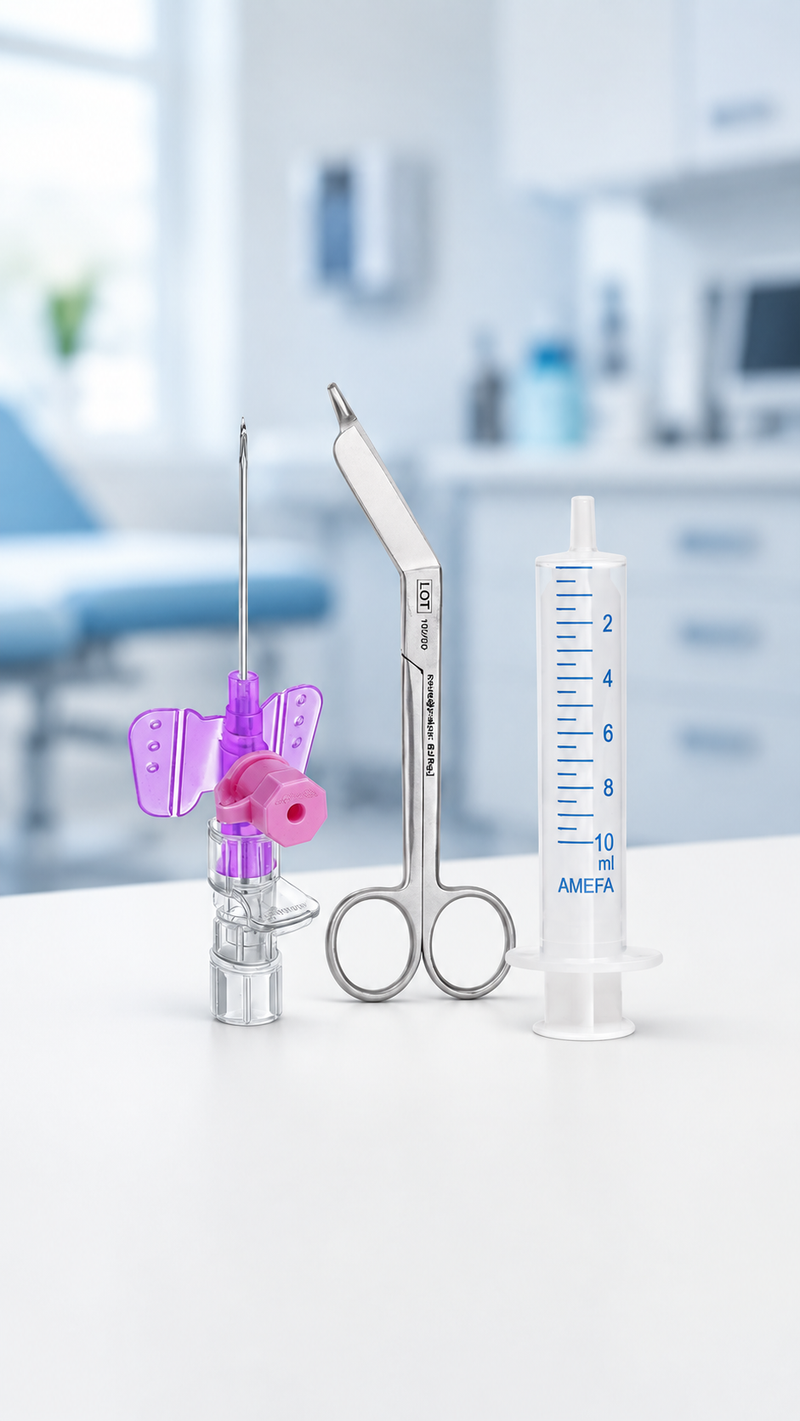
Bandage scissors are primarily intended for cutting or removing bandage materials. The sterile Lister-style bandage scissors are suitable for care settings where bandages need to be adjusted or safely cut. Their shape is designed for handling bandage materials and makes them a useful addition to medical practices, nursing facilities, or first-aid kits.
What should you look for when purchasing instruments?
When purchasing instruments, the specific area of application should be considered first. Different requirements apply to treatment in a medical practice than to first-aid kits, nursing settings, or occasional use in workplace first-aid kits. It is important to determine whether the instrument is to be used for grasping, cutting, separating, or preparing.
Sterility and packaging size also play an important role. Sterile, single-use instruments are particularly useful when hygiene requirements are a priority or when the instruments need to be ready for immediate use. Larger packages may be worthwhile for facilities that regularly work with specific instruments.
Size, shape, and handling should also be appropriate for the intended use. Tweezers must be easy to maneuver, a scalpel should be selected in the appropriate size, and dressing scissors should be suitable for the specific dressing material. For well-organized practice supplies, it is also important that instruments are stored in a clear and orderly manner, are easy to retrieve, and can be quickly replaced as needed.
Scalpels, Tweezers, and Dressing Scissors—What Are the Differences?
Scalpels are designed for precise incisions and are typically used when particularly controlled cutting is required. Disposable scalpels offer the advantage of being ready for immediate use and can be disposed of properly after use. The choice of size depends on the specific area of work and the required incision technique.
Tweezers, on the other hand, are not used for cutting, but for grasping, holding, or positioning. They are helpful when small items need to be picked up or placed with precision. Straight designs are suitable for many general applications, while specialized shapes can offer different advantages depending on the application.
Bandage scissors differ from traditional cutting instruments in that they are designed specifically for bandaging materials. They are used to adjust or remove bandages, adhesive bandages, compresses, or other materials. Therefore, the key factor in selecting the right tool is whether you need to cut, grasp, or manipulate bandaging materials.
Usage and Guidelines for Instruments
Instruments should always be used in accordance with their intended purpose. Before use, check that the packaging is undamaged and that sterile products remain properly packaged. Single-use instruments should not be reused after use but should be disposed of in accordance with the respective guidelines.
Particular care is required when handling sharp instruments such as scalpels. They should be stored securely, used with caution, and disposed of in appropriate containers after use. Tweezers and dressing scissors should also be stored in a clean, dry, and protected manner to ensure they remain ready for use when needed.
In medical and healthcare facilities, additional internal hygiene and safety guidelines apply. Manufacturer’s instructions regarding use, storage, shelf life, and disposal should always be followed.
Complementary Accessories for Instruments
Complementary categories help integrate instruments effectively into existing workflows. Cannulas and products for infusion & withdrawal cover additional medical applications, while waste containers are particularly important for the safe disposal of sharp or pointed materials. Together with other practice supplies, this creates a well-structured setup for treatment, care, and organization.


