
-
 Vendor:Sarstedt
Sarstedt Multi adapter for S-Monovette® | Pack (100 pieces)
Features: Plastic
Unit price: 0,18 €0,15 € / pieceRegular price 18,02 € 14,65 €Sale price 18,02 € 14,65 € Regular priceUnit price 0,00 € per18,02 € 14,65 €plus shipping
Delivery
-
 Up to 3% offVendor:B. Braun
B. Braun Sterican® for varicose/blood sample, with short cuts
Features: Stainless steel
Low stockDiscount −3 %Unit price: 0,052 €0,042 € / pieceRegular price From 5,20 € From 4,23 €Sale price From 5,20 € From 4,23 € Regular priceUnit price 0,00 € per5,36 € 4,36 €was
5,36 €4,36 €you save 0,16 €0,13 €plus shipping
Delivery
-

 Up to 21% offVendor:Ampri
Ampri Med Comfort Venenstauer | Pack (1 piece)
Features: Plastic
Regular price From 1,96 € From 1,59 €Sale price From 1,96 € From 1,59 € Regular priceUnit price 0,00 € per1,96 € 1,59 €plus shipping
Delivery
-
 Vendor:Sarstedt
Sarstedt S -Monovette® Serum 7.5 ml, 92 x 15 mm - Closure white - 50 pieces | Pack (50 pieces)
Features: Plastic
Unit price: 0,20 €0,17 € / pieceRegular price 10,15 € 8,25 €Sale price 10,15 € 8,25 € Regular priceUnit price 0,00 € per10,15 € 8,25 €plus shipping
Delivery
-
 Vendor:Meditrade
Meditrade tourniquet "Jetpull", blue | Pack (1 piece)
Features: Plastic
Low stockRegular price 4,99 € 4,06 €Sale price 4,99 € 4,06 € Regular priceUnit price 0,00 € per4,99 € 4,06 €plus shipping
Delivery
-

 Up to 14% offVendor:Sarstedt
Sarstedt membrane adapter for Luer systems | Pack (100 pieces)
Features: Plastic
Discount −14 %Unit price: 0,11 €0,088 € / pieceRegular price 10,84 € 8,81 €Sale price 10,84 € 8,81 € Regular priceUnit price 0,00 € per12,60 € 10,24 €was
12,60 €10,24 €you save 1,76 €1,43 €plus shipping
Delivery
-
 Vendor:W. Söhngen GmbH
One-hand tourniquet SÖHNGEN® | Pack (1 piece)
Regular price 16,85 € 13,70 €Sale price 16,85 € 13,70 € Regular priceUnit price 0,00 € per16,85 € 13,70 €plus shipping
Delivery




Other Categories


Products for professional blood collection in everyday medical practice
Blood collection is a central component of diagnostic procedures in medical practices, hospitals, laboratories, and care facilities. It serves to obtain blood samples for the analysis of various parameters and supports a well-founded medical assessment. Structured blood collection requires coordinated components that enable reliable sample collection
. Depending on the indication, blood is collected from a vein, capillary, or artery. In both outpatient and inpatient settings, the venous method is predominantly used. In this context, both the quality of the instruments used and clearly defined procedures are crucial for reproducible results. Precise handling helps prevent sample errors and streamlines the process for healthcare professionals.
The products available in this category support various collection systems, including cannulas, adapters, Monovettes, and accessories. They can be integrated into existing practice and hospital workflows and are tailored to the needs of professional users.
Components for Structured Blood Collection
Reliable blood collection requires several coordinated elements. These include suitable cannulas, adapters, collection systems, and supplementary accessories such as tourniquets. Careful selection of products supports safe puncture and stable sample collection.
Typical components for blood collection are:
- sterile cannulas in various sizes
- Adapters for Monovettes or vacuum systems
- Collection tubes with defined volumes
- Venous tourniquets for improved venous stasis
- compatible accessories for Luer and multi-system setups
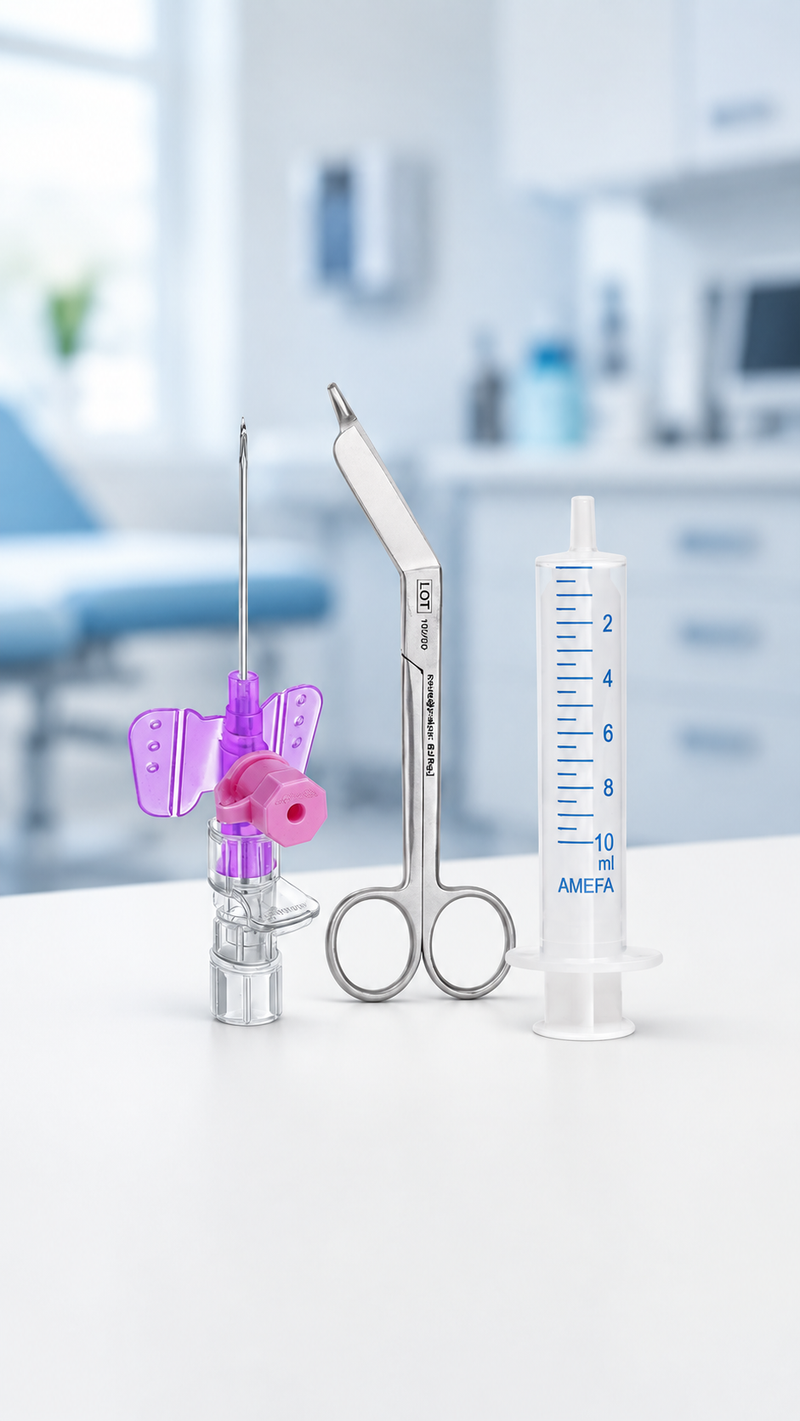
This category includes, among other items, the B. Braun Sterican for varicose vein sclerotherapy/blood collection. It is suitable for venous puncture and facilitates controlled sample collection. Also available is the Sarstedt S-Monovette Serum. This collection system enables standardized blood collection with a defined fill volume. In addition, the Sarstedt Safety-Multifly G21 cannula complements the range. It is designed for venous blood collection and can be used in combination with suitable adapters.
The selection of appropriate products for blood collection should be based on the indication, the patient’s condition, and internal quality standards.
Considerations for Safe Blood Collection in Medical Practices and Clinics
A
Safe blood collection
requires not only appropriate equipment but also structured preparation. Before the puncture, the patient’s identity, the indication for the procedure, and the required tube types must be verified. The puncture site is then disinfected and thoroughly dried to prevent contamination of the sample.
During the blood collection process, care must be taken to ensure the vein is securely stabilized and that the cannula is guided calmly and precisely. After successful sample collection, the puncture site is dressed, and the collection materials are disposed of in accordance with applicable regulations. Samples should be labeled immediately after collection to prevent mix-ups.
Safe blood collection also involves adhering to occupational safety measures. These include wearing appropriate disposable gloves, using safety-optimized cannulas, and proper disposal in puncture-resistant containers. Clear internal standards help ensure consistently high quality.
Hygienic blood collection as part of standardized procedures
Hygienic blood collection is an essential factor for valid laboratory results and the protection of staff and patients. It is based on consistent adherence to disinfection and disposal guidelines, as well as the use of suitable single-use products. Rely on structured processes to ensure consistently high sample quality.
Related product categories include:
Hygienic blood collection is most effective when all process steps are clearly defined and consistently implemented. Combined with appropriate hygiene and protective products, this creates a coordinated system that permanently integrates safety, traceability, and diagnostic quality.


